9ewentia
FINAL PROJECT
七個白板,
七個失智症患者的故事,
七個
THE MAIN THEME
9ewentia, 當我們換個角度來看待失智症,
對疾病本身,或觀看的人而言,
能否有新的意義或價值存在?
失智症的病徵,有無可能具有功能?
或帶給人的美的感受及啟發?
病程中記憶的退化,像是不斷失去的過程,
但其實也是回到最初,我們都遺忘的狀態?
9ewentia. From different perspectives, either the disease itself or the patients, can new meanings and values be uncovered in the disease?
Is it possible that the symptoms of dementia can be endowed with new functions for human beings? Or, can it bring people aesthetic emotions and inspirations?
Losing memories, one of the symptoms of dementia, is a process of constant losing. However, losing shifts us back to the primal state oblivious to us.
TEXT EFFECTS FROM SYMPTOMS OF DEMENTIA
在展場中,每個白板上都有一個失智症的故事,文字的特效則是取材自失智症患者的病徵:
記憶錯亂、重複的言語、短暫的記憶,以及視覺型阿茲海默患者的視覺失智。
我們認為,哲學家,科學家,醫生在看待失智症的病徵時,都有各自專業的角度及見解,而身為視覺設計師,我們將某些令人感到厭煩或折磨的失智症病徵,轉化成視覺特效呈現,期望能帶給人們更多元的視野來看待這些病徵。
此外,句子會在不同板子之間飛來飛去、穿梭,象徵失智症的記憶錯亂。
In the exhibition, on each whiteboard, there is a story of Dementia. The text effects come from the symptoms of patients with Dementia: Memory disorder, verbal repetition, short-term memory, and visual dissonance in patients with Posterior Cortical Atrophy. (a visual variant of Alzheimer's disease)
We believed that everyone has his/her personal or professional opinion toward the symptoms of Dementia, no matter he/she’s a philosopher, a scientist or a doctor, not to mention a graphic designer. We hope to present manifold perspectives by turning the irritating and torturing symptoms into visual effects.
Additionally, sentences will fly through different whiteboards, symbolizing memory disorder of Dementia.
STORY


WILL YOU WATCH?
THE METAPHOR OF THE WHITEBOARDS
在互動設計的巧思上,觀眾與不同板子之間的互動會影響影像消失的速度,當人靠近平板時,平板上的camera會追蹤觀眾眼睛的動態,而白板下方的計時器會顯示距離完全變白還剩下多少時間。
如果觀眾沒有看完整個故事,就會增加影片消逝的速度。如果觀眾看了故事不只一遍,反而會讓影片消逝的速度減緩。
這象徵著,如果我們沒有耐心地對待失智症患者,
他們只會不斷地退化。
反之,當我們願意多花一些心思的時候,
他們的退化速度就會有所改善。
It’s worth to note that the interaction among the audience and different iPads will affect the disappearing speed of the stories. The front cameras embedded on iPads are equipped with eye-tracking features, which will track eye movements of their approaching viewers. And, the timer beneath the whiteboard will show how much time left until it totally turns blank.
If the audience failed to finish the whole video story, it would fade away more quickly. On the other hand, the repetitive interests of the audience, reflected from their eye-movements, will decrease the disappearing speed of the stories.
This scenario also reflects the same situation of dementia patients: the less time we spend on those dementia patients, the faster they will degrade in brains. But, if we put more emphasis and care on them, it would greatly decelerate their brain degrading and improve their conditions.
TELEVISION OR SLATES
展覽期間會透過相機錄下整個過程,錄像則會以縮時的方式在會場中播放。相較於白板上每一個不可逆的瞬間,電視裡的縮時畫面可以永久保存,賦予人主導與佔有權,且可以任意倒退、跳轉。
白板上播放的故事是不斷在消逝卻真實的存在; 電視裡的錄影畫面則會不斷地累積,卻只是一個紀錄。在這樣的對比之下,你會選擇站在電視前面,還是白板前面呢?
During the exhibition, the whole process will be recorded by a camera, and the recorded footage will be presented as a time-lapse on a television. Compared to the irreversibility of the stories presented on the whiteboards, the time-lapse videos on the television can be persevered permanently. These videos give people the power to possess and control them, playing them in reverse or skipping around.
The stories presented on the whiteboards, while every-fading, are happening in real time. On the other hand, although the television continue to accumulate new videos, they are mere documentation of the past. Knowing the difference between the two, would you choose to stand in front of the television or the whiteboards?
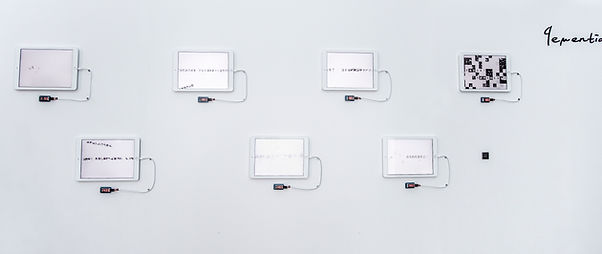
在展覽的期間,這七個故事的影像會漸漸淡去、消失,到了最後一天,七個白板都會變成一片空白。
之所以如此設計,並且用七個白板來展示故事,是因為:
在羅馬,有一個單字叫做『Tabula Rasa』(翻成英文的意思是 “blank slate” 或 “erased slate”。)
它的典故來自:古羅馬時期,學生們會在佈滿蠟的木板上寫字,並在一天的課程結束後,將這些字擦掉以供隔日上課再使用,而此時沒有任何劃記的木板被稱為“Tabula Rasa”。
後來,人們於是將Tabula Rasa 解釋為 「一個沒有任何固定想法可開始發展的狀態」,以及「人們剛出生時的心智狀態,沒有攜帶著任何想法或思想」。就如同英國哲學家John Locke所說,「人的心靈在出生時就像一塊完全卻有接受力的『空白的板子(blank slate) 』。而隨著時間的累積,經驗在這塊白板上不斷地書寫上價值觀、知識、回憶,形塑我們的個性和人生。有些想法豐富、提亮了我們的人生,有些則帶給我們難以復原的傷痕。
一般而言,失智症的患者或照顧者大多認為失智症發病的過程,就像是不斷地失去和遺忘的過程,因此感到痛苦。但我們認為,換個角度想,相較於一般人的白板只能不斷地疊加,無法輕易地擦去白板上的內容。失智症退化的過程,其實也像是回到一個一般人無法再回去的最初的狀態 -- 彷彿剛出生時,尚未受污染、純白潔淨的心靈狀態。
在這四天的展覽中,我們想邀請人們一同來欣賞這七個白板回歸到Tabula Rasa的美麗過程。
During the exhibition, these seven stories will gradually disappear on the slates. On the last day of the exhibition, the seven slates will all turn blank. The reason why we chose to present those stories with seven whiteboards is ascribed to the story down below:
There is a word called“Tabula Rasa” in Rome (often translated as blank slate or erased slate in English), which originated from an anecdote: In Ancient Rome, students would write on wooden boards filled with wax and erase all the words after the end of the course during a day, ready for use on the next day. Those waxy boards without any notes were called “Tabula Rasa” (which literally means “blank slate” or “erased slate” in English).
Then people extend the meaning of Tabula Rasa into two definitions. One is “A state that is ready to develop without any fixed ideas involve,” and the other is “the human mind as it is at birth, with no ideas or thoughts in it.” As the British philosopher John Locke said, the human mind at birth was as “white paper, void of all characters, without any ideas” just like a “blank slate” which awaited to be written with experience. As time goes on, experiences continue to be imprinted as values, knowledge, and memories on this slate and thus shape our personality and life. Some knowledge and ideas enrich and brighten our lives, while others may bring us irreparable scars.
Normally, patients or caregivers of Dementia mostly suffer from the process as if they keep unyielding and forgetting. However, from a diverse aspect, we deem that compared with the slate of ordinary people which can only be covered with new memories, people with Dementia can hardly be enumerated with any new content but be wiped out bit by bit. Eventually, the process seems to return to the blank slate as if the one’s pure mind has not been polluted at birth.
During the exhibition, we would like to invite everyone to appreciate the delicate process of how the seven slates return to Tabula Rasa.
DEFINITION
失智症 Dementia
一群會持續影響大腦認知功能疾病的統稱,表現的症狀不單是記憶力減退,其他像是語言能力、空間感、計算力、判斷力、抽象思考、注意力等功能都可能退化,甚至也會出現干擾行為、個性改變、妄想或幻覺等症狀,造成患者工作和生活功能的喪失,同時對家庭和照顧者產生重大的負擔。
Dementia is a collective term for a group of diseases that continue to affect cognitive functions in the brain. The symptoms include not only the memory loss but other functions, such as language ability, spatial sense, computation capability, judgment, abstract thinking, and attention, will all degenerate.
Even symptoms such as interfering behavior, personality change, delusion or hallucination, may occur, resulting in loss of work and life functions, and meanwhile causing huge burdens on the families and caregivers.
後部皮質萎縮 Posterior Cortical Atrophy
又稱視覺阿茲海默症 ,是由美國神經學家弗蘭克‧ 本森 (Frank Benson)於一九八八年初次提出。不像典型的阿茲海默症,患有PCA的人仍保有記憶、思考技巧以及個人見解,一直要到疾病後期才會失去這些能力。患有PCA的病患,本森寫道:「能認知目前事件,並對其困境表達出可觀的見解」。但相對地,他們經歷一種深刻且超現實的視覺失智。除了幻覺之外、報告顯示患者會突然喪失閱讀能力,以及精確感知動作、物件大小、辨識臉孔和在熟悉環境中找到路的能力。甚至有個個案是病人開始看到整個世界上下顛倒,整個反轉一百八十度。
PCA is also known as the visual variant of Alzheimer's disease, first proposed by American neuroscientist Frank Benson in 1988. Unlike typical Alzheimer's patients, people diagnosed with PCA still maintain memory, thinking skills, and personal understanding. These abilities are lost until the terminal phase of the disease.
Speaking of PCA diagnosed patients, Benson wrote: "being able to recognize current events and express deep understanding about their dilemmas." However, they experience a profound and surreal visual dementia. In addition to hallucinations, some studies indicate that the patient would suddenly lose the reading ability and the ability to accurately perceive movements and object sizes. Also, the abilities to identify faces and find the correct ways under a familiar environment would be lost. There was even a case that the patient began to see the whole world upside down with one hundred and eighty degrees of reversal.
CREDITS
組員:黃芷萱、鄭晴文
總指導老師:李根在
指導老師:何樵暐
動畫文字特效合作:芮鳳跨界整合設計有限公司合作
網站架設、眼睛追蹤程式撰寫:張力仁
電路設計與佈置:關永念
感謝所有一路走來遇到的人們,也感謝孕育我們的
台科大設計系。
Member: Léng Huang, Joy Cheng
We would like to extend our greatest gratitude to our chief instructors, Mr. Li and Mr. Ho Qiao-Wei, and those who ever contributed to our projects .
Many thanks to
Rui-Feng, Interdisciplinary Integral Design Co., Ltd. for cooperation.
Li-Ren Chang, for supporting the website and developing eye-tracking applications.
Yong-Nian Guan, for arranging and designing electric circuit.
Last but not least, the deepest appreciation to the department of design, National Taiwan University of Science and Technology (Taiwan Tech). Much appreciated.
七個白板,
七個失智症患者的故事,
七個取材自失智症病徵的特效,
在展覽的四天內回到曾經最原始的狀態。
Seven whiteboards,
Seven authentic life stories of dementia,
and seven text effects inspired by the symptoms.
During this four-day exhibition,
they will all be restored back to the primordial state day by day.